Core Specification
The OJS Core Specification defines what a job is, how it moves through its lifecycle, and what operations can be performed on it. This is Layer 1 of the three-layer architecture inspired by CloudEvents: Core (what a job IS), Wire Format (how it is SERIALIZED), and Protocol Bindings (how it is TRANSMITTED).
Design Principles
Section titled “Design Principles”Seven principles guide the specification and should guide implementation decisions:
- Backend-agnostic. Redis, PostgreSQL, Kafka, SQS, in-memory, all valid backends as long as they conform.
- Language-agnostic. A JavaScript app and a Go app should share the same job definitions and interoperate through a common backend.
- Protocol-extensible. HTTP, gRPC, AMQP, and other bindings are defined in separate companion specs.
- Simple JSON-only arguments. Job arguments use JSON-native types only. This forces clean separation between job definition and application state.
- Convention over configuration. Sensible defaults for every configurable parameter.
- Server-side intelligence, client simplicity. Retry logic, scheduling, and state management live in the backend. Clients need only implement PUSH, FETCH, ACK, FAIL, and BEAT.
- Observable by default. Structured error reporting and lifecycle events are first-class concepts.
Job Envelope
Section titled “Job Envelope”The job envelope is the core data structure. It contains everything needed to identify, configure, route, execute, and track a background job. Attributes fall into three categories.
Required Attributes
Section titled “Required Attributes”Every valid job envelope must include these five fields:
| Attribute | Type | Description |
|---|---|---|
specversion | string | OJS spec version (e.g., "1.0.0-rc.1") |
id | string | UUIDv7 job identifier |
type | string | Dot-namespaced job type (e.g., "email.send") |
queue | string | Target queue name. Defaults to "default" |
args | array | Positional arguments for the handler. JSON-native types only. |
The type field routes jobs to the correct handler. It uses dot-separated namespacing (billing.invoice.generate) to prevent collisions across teams. The args field is an array, not an object. This design, proven by Sidekiq over a decade, forces developers to pass identifiers rather than serialized objects, preventing stale data bugs and enabling cross-language interoperability.
Optional Attributes
Section titled “Optional Attributes”| Attribute | Type | Default | Description |
|---|---|---|---|
meta | object | {} | Extensible metadata for cross-cutting concerns (trace IDs, locale, tenant ID) |
priority | integer | 0 | Higher values mean higher priority |
timeout | integer | impl-defined | Max execution time in seconds |
scheduled_at | string | — | ISO 8601 timestamp for future execution |
expires_at | string | — | ISO 8601 deadline after which the job is discarded |
retry | object | impl-defined | Retry policy (see Retry Policies) |
unique | object | — | Uniqueness policy (see Unique Jobs) |
schema | string | — | URI referencing a schema for args validation |
The meta object is the primary extension mechanism. Implementations must preserve all keys through the job lifecycle without modification. Well-known keys include trace_id, tenant_id, locale, and correlation_id.
System-Managed Attributes
Section titled “System-Managed Attributes”These are set by the implementation. Clients must not set them, and implementations must ignore client-provided values.
| Attribute | Type | Description |
|---|---|---|
state | string | Current lifecycle state |
attempt | integer | Current attempt number (1-indexed) |
created_at | string | ISO 8601 creation timestamp |
enqueued_at | string | ISO 8601 enqueue timestamp |
started_at | string | ISO 8601 execution start timestamp |
completed_at | string | ISO 8601 terminal state timestamp |
error | object | Last error information |
result | any | Job result value |
Job Lifecycle State Machine
Section titled “Job Lifecycle State Machine”Every job progresses through exactly eight states. The state machine is enforced by the implementation, and invalid transitions must be rejected.
States
Section titled “States”| State | Description | Terminal? |
|---|---|---|
scheduled | Has a future scheduled_at time, waiting for it to arrive | No |
available | Ready for pickup by a worker | No |
pending | Staged, awaiting external activation | No |
active | Claimed by a worker, currently executing | No |
completed | Handler executed successfully | Yes |
retryable | Handler failed, but retry attempts remain | No |
cancelled | Intentionally stopped via CANCEL | Yes |
discarded | Permanently failed (retries exhausted) or manually discarded | Yes |
State Diagram
Section titled “State Diagram”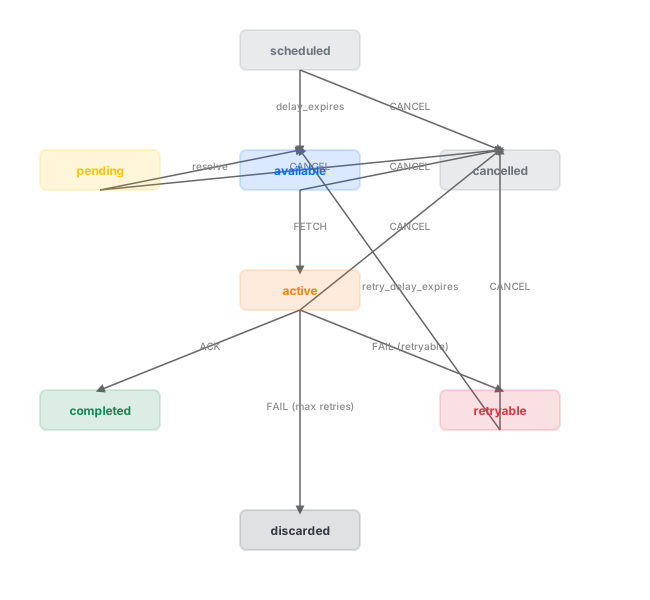
ASCII version
┌─────────────────────┐ │ PUSH │ │ (enqueue a job) │ └──────────┬──────────┘ │ ┌─────────────────────┼─────────────────────┐ │ │ │ ▼ ▼ ▼ ┌─────────────┐ ┌─────────────┐ ┌─────────────┐ │ scheduled │ │ available │ │ pending │ └──────┬──────┘ └──────┬──────┘ └──────┬──────┘ │ │ │ │ time arrives │ │ external └───────────────────►│◄────────────────────┘ activation │ │ worker claims ▼ ┌─────────────┐ │ active │ └──────┬──────┘ │ ┌────────────┬────────┼────────┬─────────────┐ │ │ │ │ │ ▼ ▼ │ ▼ ▼ ┌───────────┐ ┌──────────┐ │ ┌──────────┐ ┌───────────┐ │ completed │ │retryable │ │ │cancelled │ │ discarded │ └───────────┘ └────┬─────┘ │ └──────────┘ └─────┬─────┘ │ │ │ │backoff │ │ manual │expires │ │ retry └───────►│◄────────────────────┘ ┌─────────────┐ │ available │ └─────────────┘Valid State Transitions
Section titled “Valid State Transitions”| From | To | Trigger |
|---|---|---|
| (initial) | scheduled | PUSH with future scheduled_at |
| (initial) | available | PUSH without scheduled_at |
| (initial) | pending | PUSH with pending flag |
scheduled | available | Scheduled time arrives |
available | active | Worker claims via FETCH |
pending | available | External activation |
active | completed | ACK (handler succeeded) |
active | retryable | FAIL (retries remain) |
active | cancelled | CANCEL while executing |
active | discarded | FAIL (retries exhausted) |
retryable | available | Backoff delay expires |
discarded | available | Manual retry from dead letter |
State transitions must be atomic. Only one worker can claim a job. Terminal states are permanent, with the sole exception of optional manual retry from discarded to available.
Logical Operations
Section titled “Logical Operations”Seven abstract operations define what can be done with jobs. Protocol bindings (HTTP, gRPC) define the concrete wire interactions.
Enqueue one or more jobs for asynchronous processing. The implementation validates the envelope, sets system-managed attributes, enforces uniqueness if configured, runs enqueue middleware, and returns the complete job envelope.
Dequeue jobs for processing. The implementation selects the highest-priority available job from specified queues, atomically transitions it to active, increments the attempt counter, and associates a visibility timeout.
Acknowledge successful completion. Transitions the job from active to completed and optionally stores a result value.
Report that execution failed. Provides a structured error object. The implementation evaluates the retry policy: if retries remain and the error is retryable, the job moves to retryable. Otherwise it moves to discarded.
Worker heartbeat. Extends the visibility timeout of active jobs and reports worker liveness. The server may respond with lifecycle directives (running, quiet, or terminate).
CANCEL
Section titled “CANCEL”Cancel a job in any non-terminal state. For active jobs, the server sets a cancellation flag that the worker can check via heartbeat.
Retrieve the current state and full envelope of a job. Read-only, no side effects.
Error Reporting
Section titled “Error Reporting”When a job fails, the error must be reported as a structured object:
{ "type": "SmtpConnectionError", "message": "Connection refused to smtp.example.com:587 after 30s timeout", "backtrace": [ "at SmtpClient.connect (smtp.js:42:15)", "at EmailSender.send (email_sender.js:18:22)", "at handler (handlers/email.send.js:7:10)" ]}The type field enables pattern matching on errors (e.g., “retry on ConnectionError, discard on ValidationError”). The backtrace is an array of frame strings, limited to 50 frames or 10,000 characters.
Middleware
Section titled “Middleware”OJS defines two middleware chains:
- Enqueue middleware runs before a job is persisted during PUSH. It can modify the envelope, inject metadata (like trace IDs), validate arguments, or prevent enqueueing entirely.
- Execution middleware wraps job execution on the worker side. It enables logging, metrics, error handling, and context propagation.
Both chains use the next() pattern, where each middleware invokes the next in the chain.
Worker Lifecycle
Section titled “Worker Lifecycle”Workers have three lifecycle states, communicated via heartbeat responses:
| State | Description |
|---|---|
running | Normal operation. Fetches and executes jobs. |
quiet | Stops fetching new jobs but finishes currently active ones. Used during graceful deployment. |
terminate | Stops fetching and shuts down after active jobs complete or a grace period expires. |
This three-state model, borrowed from Faktory and Sidekiq, enables zero-downtime deployments: send quiet to all workers, deploy new code, start new workers, then terminate old workers.
Extension Points
Section titled “Extension Points”The core specification is intentionally minimal. Extensions are defined in companion specifications:
- Retry Policies (ojs-retry.md): Backoff algorithms, jitter, non-retryable error classification.
- Unique Jobs (ojs-unique-jobs.md): Deduplication dimensions, key computation, conflict resolution.
- Workflows (ojs-workflows.md): Chain, group, and batch primitives for composing jobs.
- Cron / Periodic Jobs (ojs-cron.md): Recurring schedules, timezone handling, overlap prevention.
- Lifecycle Events: Standard event vocabulary for job lifecycle tracking.
- Custom Attributes via
meta: The primary extension mechanism for user-defined attributes.